
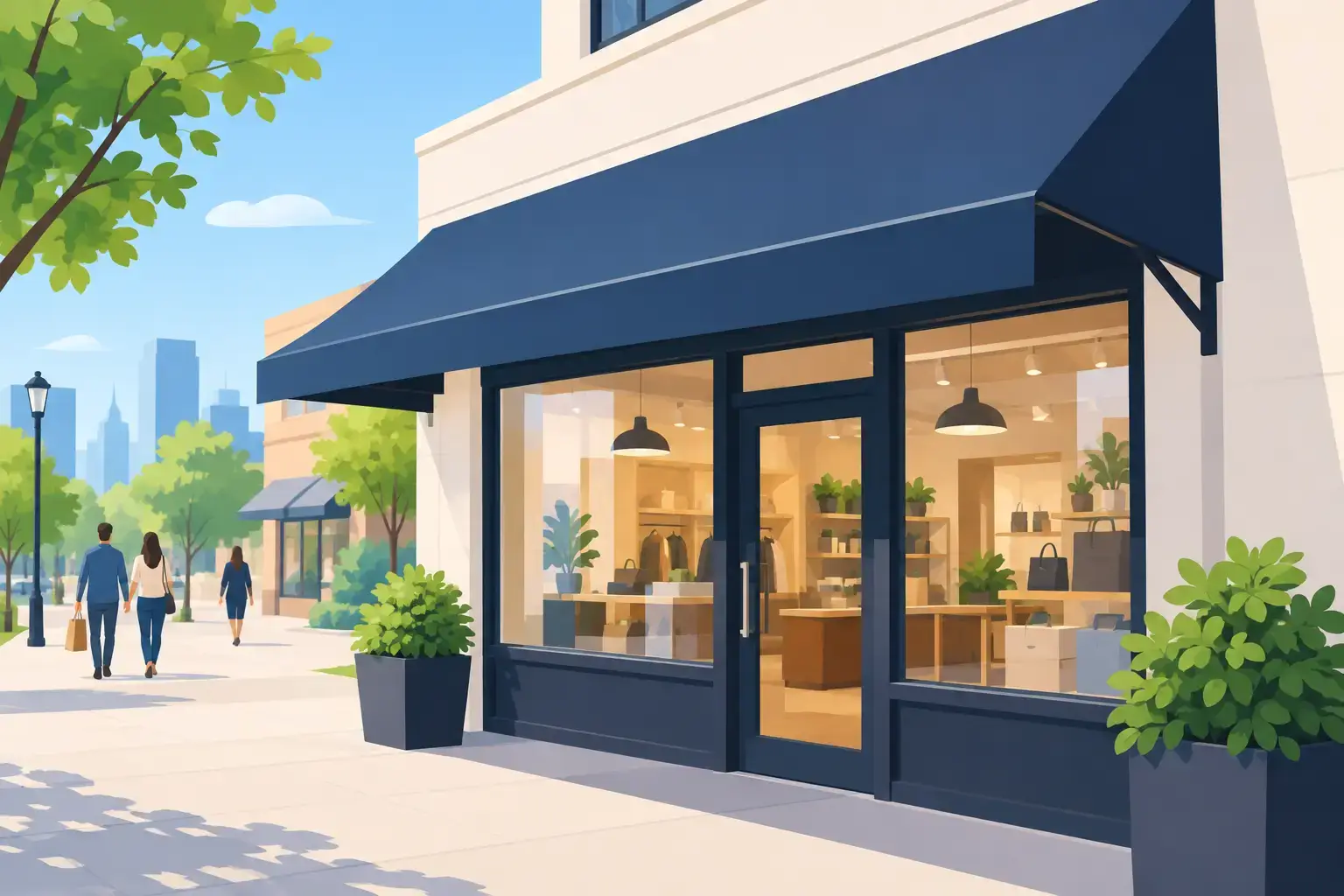
A customer may have only a few seconds to notice your business from the street, decide what you offer, and feel confident enough to pull in. That is how commercial awnings boost visibility: they give a storefront more shape, color, contrast, and presence at the exact point where people are making that decision.
For businesses across Southwest Florida, an awning is more than protection from the sun and rain. It is a custom exterior feature that can make an otherwise flat building easier to spot, easier to remember, and more inviting to enter. When it is designed around the building, brand, signage, and customer approach, it works as a practical part of your storefront identity every day.
Commercial Awnings Create a Clearer Storefront
Many commercial buildings share similar materials and proportions. Stucco walls, glass doors, plazas, and parking areas can blend together, particularly under Florida’s bright midday sun. A well-designed awning breaks up that visual sameness.
The projection from the building creates depth and shadow, which makes the entrance or window line more noticeable from different angles. It also establishes a visual destination. Instead of customers searching along a row of doors, they can immediately identify the covered entrance, service window, or outdoor seating area.
This matters for retail stores, professional offices, restaurants, salons, medical practices, and hospitality properties. A customer-facing exterior should answer a simple question quickly: where do I go? Awnings help provide that answer without overwhelming the building.
Color Makes Recognition Easier
Color is one of the strongest visibility tools available in a commercial awning. A fabric color that complements your logo or existing signage helps create consistency between your business name and your physical location. A contrasting color can also help an entrance stand apart from the surrounding façade.
The right choice depends on the building and the setting. A dark awning can look polished and provide strong contrast against a light exterior, but it may absorb more heat and show fading differently over time. A lighter color can feel clean and reflect more sunlight, although it may not create the same visual contrast on every building.
Custom fabrication gives business owners more control over those choices. Rather than settling for a standard size or color, the awning can be sized and shaped to suit the architecture, storefront width, and desired level of visibility.
How Commercial Awnings Boost Visibility Beyond Signage
Signage tells people who you are. An awning helps people notice where you are. Used together, they create a much stronger first impression than either feature can provide alone.
An awning can frame a sign mounted above an entrance, bring attention to lettering placed on its valance, or create a backdrop that makes an existing sign easier to read. For a business in a busy retail center, that extra visual layer can be especially valuable. Customers are often viewing the storefront while driving, walking through a parking lot, or looking past neighboring businesses.
There is a practical limit, however. Awnings should support readable branding, not compete with it. Too many colors, oversized graphics, or a shape that blocks an existing sign can make the storefront feel cluttered. The best design considers the full façade as one composition: sign placement, window locations, entry points, building materials, and the direction customers approach from.
Shape Directs the Eye
Traditional slope awnings, dome styles, entrance canopies, and custom configurations each create a different effect. A long continuous awning can unify several storefront windows and make a wide façade feel more established. A smaller entrance canopy can focus attention precisely on the door.
Restaurants may use a series of awnings to define windows and outdoor dining areas. Offices may benefit from a clean, tailored entrance awning that adds distinction without appearing overly decorative. Hotels and service businesses may need a larger covered arrival area that is visible from the driveway while also offering genuine weather protection.
The best choice is not always the largest awning. Scale should match the property. An oversized structure can overpower a small storefront, while one that is too narrow may disappear against a larger building. Custom sizing helps strike that balance.
Visibility Improves When Customers Feel Welcome
Storefront visibility is not only about being seen from a distance. It is also about making the entrance feel approachable once customers arrive. In Southwest Florida, intense sun and sudden rain can make an uncovered doorway less comfortable, especially for guests carrying packages, parents with children, or customers waiting for a door to open.
A commercial awning provides a shaded transition between the parking area and the building. It helps reduce glare at windows and doors, offers shelter during passing showers, and makes the front of the business feel cared for. Those details influence how customers perceive the business before they step inside.
For restaurants and cafés, shade structures can also make outdoor seating more usable during more hours of the day. For retail shops, shaded display windows may be easier for pedestrians to view. For professional offices, a defined covered entry can add a sense of permanence and organization.
Placement Matters as Much as Design
Even a beautiful awning will not do much for visibility if it is installed without considering sightlines. Before selecting a style, business owners should look at the property from the road, the parking lot, and the primary pedestrian path. Consider where drivers first see the building and whether trees, neighboring signs, parked vehicles, or architectural features block the view.
An awning over a side entrance may improve customer flow but do little for road visibility. In that case, a coordinated front awning or a more visible color choice may be needed. Likewise, an awning placed too high can lose its welcoming effect, while one positioned too low can interfere with signage or create clearance concerns.
Local conditions matter as well. Southwest Florida sun exposure, wind, rain, building requirements, and the needs of the specific property should shape the final design. A licensed, insured contractor can help business owners choose a structure that looks right while being properly planned for the location.
Daytime Presence and Evening Appeal
Commercial awnings are most often selected for their daytime benefits, but they can also improve how a business presents itself later in the day. Exterior lighting aimed at the storefront, entry, or sign can create attractive shadows and make the awning’s shape visible after sunset.
Lighting should be planned carefully. The goal is clear, welcoming visibility, not harsh glare for drivers or nearby tenants. In some cases, a lighter awning color will reflect nearby lighting more effectively; in others, a darker color will make illuminated lettering stand out. The relationship between the awning, sign, and lighting is worth considering before installation rather than correcting after the fact.
A Long-Term Exterior Upgrade, Not a Quick Cover
A commercial awning needs to work hard over time. It will be exposed to sun, moisture, wind, and the daily wear of a busy customer environment. Materials, frame construction, fabric selection, attachment methods, and professional installation all affect how well it holds its appearance and performs.
This is where a custom approach has real value. A mass-market product may seem like a quick answer, but it may not fit the storefront properly or provide the durability needed for a commercial setting. A custom-built awning is designed around the actual dimensions and conditions of the property, helping it look intentional rather than added as an afterthought.
Accent Awning Company brings more than 40 years of local experience to commercial shade structures throughout Southwest Florida. That experience helps business owners move from a general idea – “we need to stand out more” – to a design that fits the building and supports the customer experience.
A strong storefront does not have to rely on a larger sign or a complete exterior renovation. Sometimes the right awning gives a business the visual definition, shade, and welcome that customers notice first – and remember when they are ready to return.
